

Why this influencer’s strength training “method” concerns me
A note to Lee (and to you)

Hey friends: I normally try not to pop into your inbox more than twice a week. But this one felt timely and I didn’t want to wait on it until next week! Promise I’m not changing my publishing cadence going forward — just wanted to get this off my chest while it’s still relevant. Hope you find it helpful.
Dear Lee,
I don’t spend a lot of time in influencer-land. I’ve noticed that the more aspirational content I see online, the worse I feel about myself, and the more money I end up wasting on things I don’t need. That isn’t a you problem, it’s a me problem, but I just want you to know that your area of the internet is a little unfamiliar to me.
But algorithmically-driven feeds will do their thing, and so of course when you unveiled your new strength training program to your audience here on Substack last week, my Notes feed presented it to me. [HTM readers, ahead is a link to the post in question. Before you click it, know that it is not an anti-diet approach and may not be a good choice for all to read. Here you go.]
I’d heard of you before but knew very little about your work or expertise (but from my recent dive into your Instagram, I can say I absolutely loved your wedding photos — that dressssss — and given that you’re a member of the Park Slope Food Coop, I think we might be neighbors! That’s fun). I was curious to know what you were recommending, so I read your post with great interest.
I have some thoughts I’d like to share with you, as someone who cares deeply about how fitness is promoted and explained on the internet, especially to women, because I get the sense that you feel the same way. Not all of the thoughts are critical! But some of them are. And I hope you receive this with the good intentions with which it was written — because I also see the many good intentions you have in sharing the information you’ve put out there. I love that you’ve had such a good experience with strength training and that you want to share it with your (sizeable!) audience.
I also love that you’re feeling great in your body, but Lee: Using before-and-after photos to share your visual results is not as harmless as I assume you think it is. And listen, I wasn’t surprised to see that in addition to the many non-aesthetic benefits of strength training, you’re putting a lot of emphasis on potential aesthetic changes. It’s not my vibe, but it is very common! Most people in the wellness space are heavily influenced by diet culture — I’ve been a certified personal trainer for 11 years and still get very excited when I meet another anti-diet trainer, because we are the exception to the rule. (And I understand from your pinned post on IG that you’ve been on quite a journey with this stuff yourself, and thought deeply about it.)
So yes, some of what I’d like to say to you is about the diet culture of it all. Plenty of it isn’t. Let’s get into it all.
Here’s what I was glad to see:
I love the way you describe the sustained energy, confidence, and strength you’re feeling as a result of your newfound strength training habit. Those are some of the best parts of the whole thing, and I’m so glad you highlighted them because they’re also some of the most motivating benefits long-term. They help exercisers build intrinsic motivation, which is so much more powerful than extrinsic motivators like appearance or social clout.
Your plan is focused on, basically, boring old strength training with a progressive overload approach, which is exactly what we know works for people who want to build strength and muscle mass. You’re doing an upper-lower split and training each muscle group twice a week, working close to failure, and adding weight and/or reps when things start to feel easy, which all adhere to the latest official guidance on strength training.
The exercises you’re recommending are pretty good overall, and nicely well rounded. I’d gently suggest you call them “lateral raises” instead of “lat raises” — only because the latter (heh) can be a bit confusing, since they don’t work your lats at all (mostly your delts!). I’m not sure what you mean by “overhead crunches”: the kneeling kind with the rope attachment on a cable machine, or the supine kind with your arms overhead, but both are solid moves (although a lot of people have a hard time doing the kneeling kind correctly).
Here’s what raised my eyebrows:
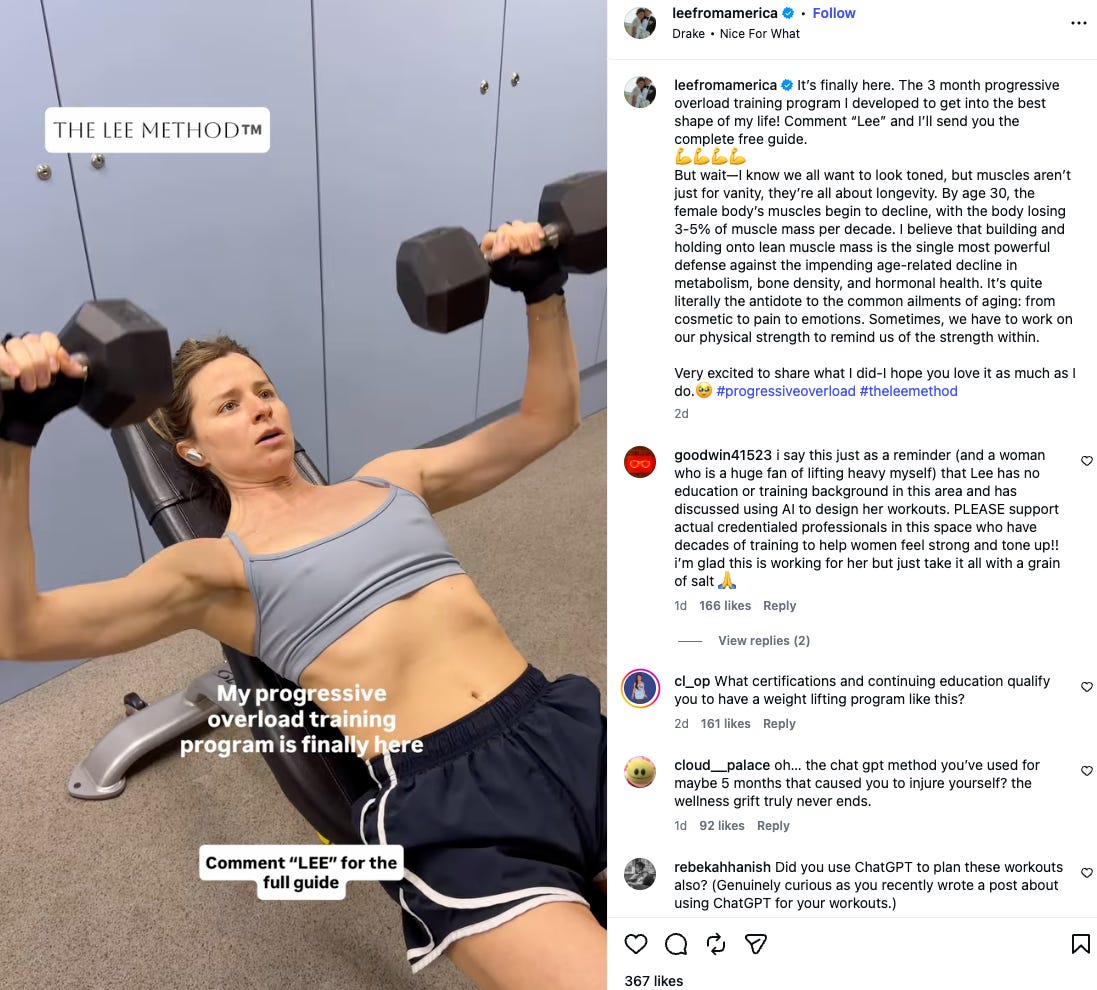
In your Substack post, you admit that you’re not a certified personal trainer, and you say you developed your method by doing “a lot of research.” Yet in an Instagram video, you describe this research by saying, “I watched a lot of YouTubes, I asked ChatGPT.” In another IG video from about three months ago, you reveal that, at that point, you’d been doing progressive overload training for eight weeks. Look, strength training is relatively straightforward and does not necessarily require any certifications to figure out. It is beginner-friendly! But suggesting your “method” is so solid and research-backed that it’s worth sharing with your audience — when really it’s based on a few weeks of personal experience and some advice from AI and YouTube — is a little…bold, to say the least. There are so many credentialed experts out there with years of experience working with actual clients: Why not use your platform to promote the expertise of one of them! (Doesn’t have to be me, lol!) Relying on actual experts helps ensure the safety and accuracy of your guidance and lends your “method” much more credibility.
And, ok, I’m sorry for the sarcastic quotation marks around the word method up there, but I really don’t love the way you framed your program. The name makes it sound like you’re doing something unique and proprietary, when really it’s just a standard (and fine!) progressive overload program. And not to nitpick, but “method” reminds me of a few things: The Barre Method. The Tracy Anderson Method. Hell, even the Pilates method. Not all of these are created equal (I genuinely love Pilates), but they’re all giving exclusive, fancy, skinny-blonde-white-lady vibes. So.
You give the overall guidance to use a weight that feels hard by the last rep if you’re new to strength training, and hard for the last two reps if you have more experience. I guess this is mostly fine, but “hard” is subjective — I prefer explaining that you could almost not complete another rep or two or you’d lose your form. BUT (more on this in the next section).
Ok, this is maybe just a unique passion of mine, but I am constantly preaching the gospel of starting very small when it comes to strength training. If a new exerciser goes from zero resistance work to the prescribed weights and reps you’re suggesting (if they can even manage them at all; again, more on that in a moment), they’re very likely going to be sore as hell. They will not be able to do all four strength workouts in their first week; after days one and two, they might not even be able to go down the stairs or get up from the toilet without holding onto something. Some people love that kind of hellacious soreness; most, in my experience, are extremely discouraged by feeling so unable to function. I would love to see you be clear on the importance of easing your way in.
You promote the idea of taking 10,000 steps per day. While there isn’t anything inherently wrong with this goal, that supposedly magical number has been pretty thoroughly debunked. And walking is great for you, but that amount of walking is incredibly time-consuming (it takes about 90 minutes, depending on your pace). Our societal all-or-nothing thinking can take hard-to-achieve numbers like that and — instead of making us say, “Well, how about 5,000 instead?” — leave us feeling defeated and like it isn’t worth even trying. Plus, you’re recommending this step count every day, including lifting days: That could be more than two hours of exercise, which is a ton for anyone with a job or caregiving responsibilities (or, really, much of anything going on). It’s an amount of movement that, if a client were doing it, I’d want to keep an eye on.
Here’s what really concerned me:
Let’s talk about those before-and-after photos. Among the issues here:
Promoting the potential aesthetic changes of an exercise modality is perpetuating diet culture. It can be triggering to those who have, or are in recovery from, eating disorders — or truly anyone who feels some type of way about their body.
The way your body responds aesthetically to exercise (or doesn’t) is almost entirely dependent on your genetics and your diet. You cannot change your genetics. And dietary changes for aesthetic purposes are a real slippery slope into disordered eating (more on that in a moment).
It’s really just the oldest, and most duplicitous, trick in the fitness-marketing book. You don’t look that way (either before or after!) solely because of a workout plan you’ve been following, and you cannot guarantee that anyone else will, either. I am also a skinny white lady and I do not use my own body as my calling card or marketing tool: I don’t look like this primarily because of the way I exercise, and neither will my clients or subscribers. (And though I plan to keep strength training forever, I am under no illusions that my body will look this way forever.)
Your 25-ish words of “body recomp” advice is misleading and oversimplified at best, dangerous at worst. You don’t cite or link to any resources or guidance from a registered dietitian or other credentialed professional (aside from a podcast appearance by Stacy Sims, whom I’ll get to in a moment), and perhaps more importantly, you don’t include any caveats about folks for whom pursuing intentional weight loss (or “fat loss,” the more popular term these days) may not be safe. Which is…a lot of people. Nine percent of the U.S. population will have an eating disorder in their lifetime (according to my research, you yourself are among them), and countless more engage in disordered eating or unhealthy weight loss–oriented dieting that causes harm to their bodies and brains but wouldn’t necessarily check all the boxes of a diagnosable eating disorder. I’m not saying that no one on earth can pursue intentional weight loss safely, but it’s tricky, and it’s fraught, and given that you are a caring-seeming person with a large platform who has so bravely and vulnerably discussed your own history with an eating disorder, I’d love to see you going about this in a more careful, harm reduction–oriented way.
Despite your mostly-reasonable guidance (see above) for how to select weights based on perceived challenge level, you go on to prescribe very specific weights and reps for each movement. This is something a trainer who knows a client’s body, goals, needs, and strength level very well could provide for them, but absolutely not something a generic program should be specifying. The weights you’re suggesting may be a great starting point (or even, maybe, too light) for some people — and they’ll be way too heavy for others, leading to wonky form and even injury if they don’t slowly work their way up to that level. I have worked with so many beginners who are absolutely stronger than they give themselves credit for, but still could not possibly manage a chest press with 25 pounds in each hand, or a 15-pound bicep curl, when first starting out. Not for 10 reps, not even for one rep.
And: If someone tries these weights and cannot handle them, that’s just a shitty feeling! I can hear the inner monologue now: She’s a beginner, too, and she’s tiny, but she’s telling me to use weights that I cannot even remotely lift. I’m so weak. This isn’t for me. This is why I almost never suggest specific weights in my exercise videos or even talk about the weights I’m using (beyond just “light”/“medium”/“heavy”): Our perfectionist culture causes so many of us to play the comparison game, and feel beyond awful if we don’t think we measure up to where we “should” be.
(To be clear, I am not saying these are bad weights to use, or that women shouldn’t be lifting heavy. I obviously do not feel that way!)
You state that your approach to cardio, as well as some of your nutrition guidance, is based on the work of Stacy Sims. But so much of the messaging Sims promotes is based on wild over-extrapolation of things like rodent studies and her personal observations of her work with elite female athletes, and plenty of it — including the many cycle syncing programs she has sold to major fitness corporations — has been thoroughly debunked. I wouldn’t expect you to know how controversial Sims’ work is because you are not deeply embedded in the fitness world. (But that’s yet another reason why I’m not sure you should be promoting your own strength training program to a wide audience.)
You and I agree that pretty much everyone could benefit from strength training, and we both want more people experiencing all the things we both love about it. But women deserve so much better than your AI-generated plan, your complete lack of expertise and near-complete lack of experience, and the careless way you’ve communicated about numbers, food, and aesthetic changes.
I hope you take this feedback — and all the feedback you’ve received on Instagram — with the goodwill I’m sharing it with. Thank you for using your platform to promote a genuinely life-changing, health-promoting behavior. Please, please just consider being more thoughtful about how you approach the topic going forward.
xo
Anna
Thanks for this, Anna.
Thank you for sharing this! I started following lee from america in 2016 when I moved to LA. I got fun ideas from her like "hang eucalyptus in your shower and feel like you're in a spa" or "try dry brushing" all of which I did. But she decamped from social media (see the NYT piece on her: https://www.nytimes.com/2023/04/11/style/lee-tilghman-influencer.html) I'm confused she is back in this space, and in an area she has no training in.
So as a social scientist, I really appreciate your approach to this. Hopefully she heeds the feedback and offers to point folks in the direction of seasoned professionals with decades of experience, present company included.